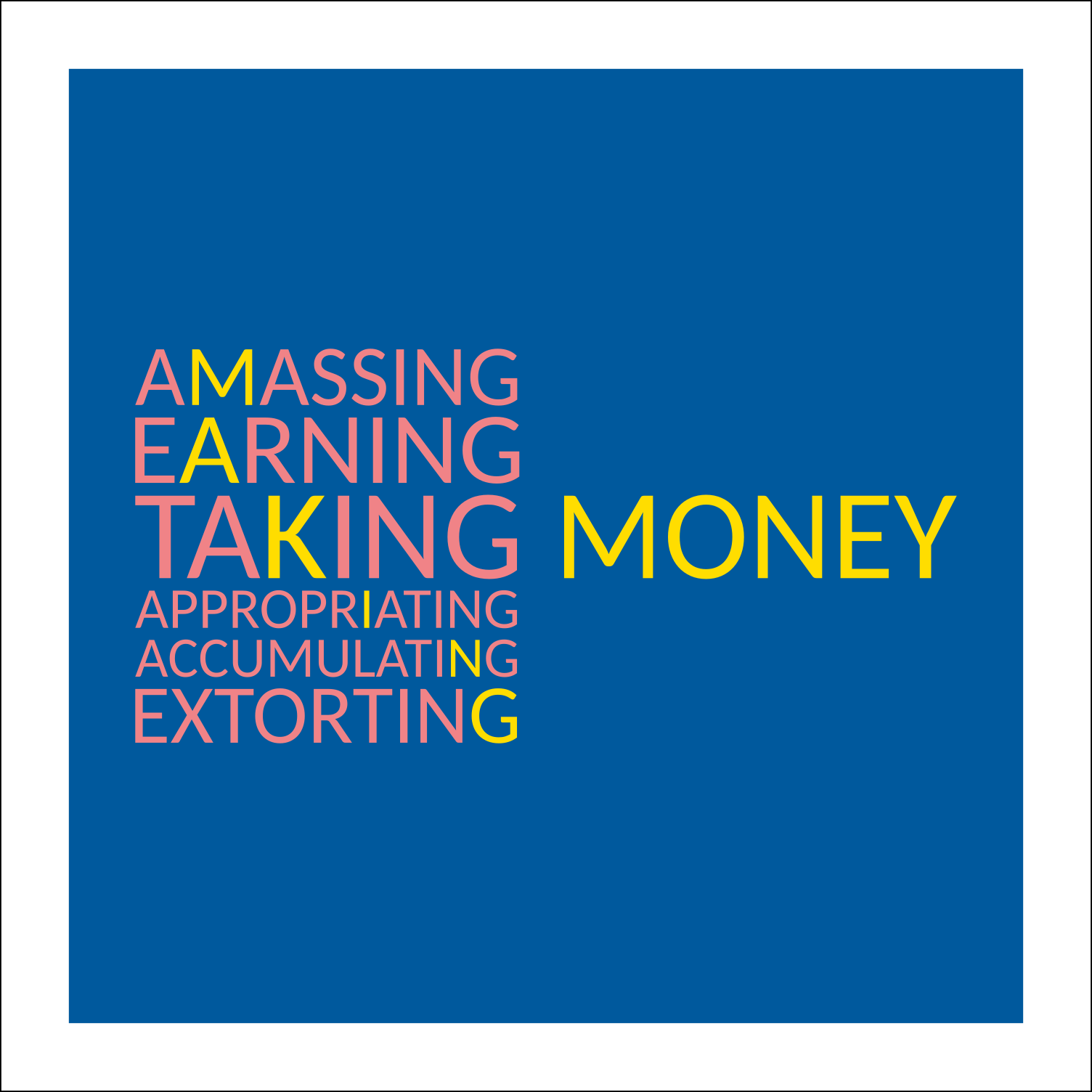
Taking, not Making
The rich don’t “make money” because only governments can do that. They’re just more successful at extracting the biggest share.
Share this image
The expression “making money” creates a totally misleading picture of how the money economy works.
Since 1972, when the US abandoned the gold standard, and in most cases for much longer than that, the world’s currencies have been “fiat” currencies. Fiat is Latin for “let it be so”, and a fiat currency has value only because a government says that it does.
Because it is not connected to anything of physical value, there is no limit to the amount of money a government can create. So managing the value of money is an important government responsibility. The key is to ensure that the correct amount of money is in the economy at any time.
What is the correct amount? To answer this we need to understand what money is for. Since money has no physical value it shouldn’t be thought of as wealth as such. It is more accurate to describe money as a tool that helps in the creation of wealth. It allows people more easily to trade goods, materials and their skills so that they have what they need to produce real wealth – the food, shelter, clothing and myriad other things that will improve the quality of their lives.
The correct amount of money in the economy, therefore, is the amount that will allow as much of that real wealth as possible to be created. That doesn’t mean, however, that making more money available will produce more. Plenty of real wealth can be produced with very little money, and if too much money is available people may stop producing wealth in the expectation that they can simply buy it from others.
That’s why too much money causes inflation. People try to buy, rather than produce, the wealth they need, so prices go up. Too little money, however, is also a problem, because it stops people from producing. That is why the UK’s austerity policies of the last 15 years have been so disastrous, both economically and politically.
Because money has no real physical value, but mostly exists as numbers in a computer, the government doesn’t actually keep it or bank it. Instead it simply creates new money through spending (schools, NHS, roads, armed forces, pensions, etc). In the same way, the money it takes out through taxation (income tax, VAT, fuel duty, etc) is simply binned. The same thing happens when the government sells assets, such as publicly-owned businesses or land: the money is just cancelled. And this also happens when the government borrows money by selling bonds, or gilts. The borrowed money disappears and will be created anew when the time comes to pay it back.
Through these and other methods the government is constantly balancing the amount of money in the economy. The idea is to keep it as active as possible but not to tip it over into inflation. The job is made harder, however, by the other way in which money enters the economy, which is via commercial bank loans.
The government allows private commercial banks to lend money that they do not have, and in doing so new money is created. This money is then cancelled when the loan is paid off. The government could quite easily control to whom and for what purpose this money is lent, in order to ensure that it is going towards activities that will create real wealth. But because it doesn’t control lending in this way, much of this new money goes into higher land and house prices, higher share prices and other forms of financial trading activity, where no real wealth is created.
Because the government makes all money, it has an enormous responsibility to make sure that the money is going wherever it is most effective in creating real wealth. Every pound salted away in a rich person’s bank account is a pound that is not being used by a hungry family to make a meal.
Videos relating to this image
Postcards and T-Shirts